


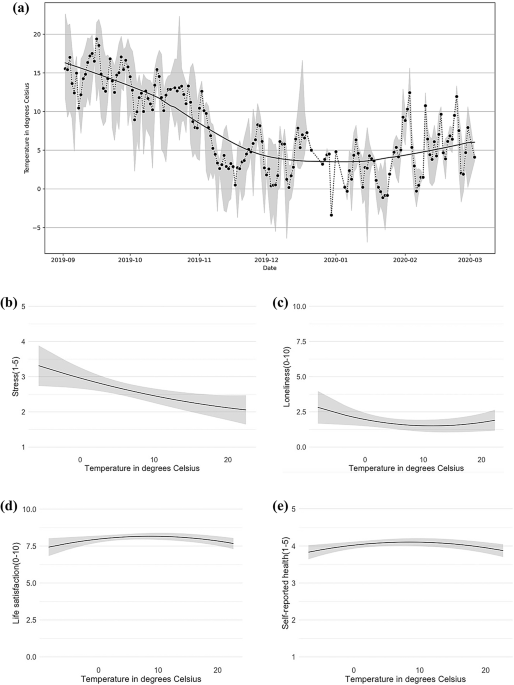
The present study yielded the following main findings. First, the higher the average ambient temperature in cold seasons, the lower the stress levels. Second, intermediate temperatures were associated with less loneliness, better life satisfaction, and better self-reported health. Third, there was no relationship between temperature and affect, optimism, strength, and energy.
Our fist finding was that higher ambient temperatures during cold seasons in the 30 days prior to the survey were related to lower reported stress experienced over the past 30 days. This finding is novel in that, to the best of our knowledge, no previous studies have investigated the relationship between ambient temperatures and stress. However, emerging findings from experimental research suggest that warmth may potentially alleviate acute stress responses13. Given that stress is one of the most significant risk factors for mental health problems14, warm temperatures might exert protective effects, above and beyond the well-established effects of light15. Indeed, one study has shown that ambient temperature was predictive of disorders treated with selective serotonin reuptake inhibitors (e.g., depression and anxiety), but not of substance use disorders16.
Our second finding was that intermediate cold-season ambient temperatures in 14 days prior to the survey were associated with less loneliness, better life satisfaction, and better self-reported health. Regarding loneliness, cold-season outdoor temperatures above 0 °C and up to 20 °C appeared to be protective against loneliness, whereas outdoor temperatures below 0 °C appeared to exert the opposite effect. Again, we are not aware of any previous studies investigating associations between ambient temperatures and loneliness. However, our findings complement experimental work, which has demonstrated that indoor temperatures between 22 °C and 24 °C mapped onto a more relational focus and feeling closer to others when compared to cooler room temperatures10. Regarding life satisfaction, cold-season temperatures between 0 °C and 10 °C appeared to lead to higher levels of life satisfaction, whereas temperatures below 0 °C appeared to lead to lower levels. Our study adds to previous observations in climatically cooler countries, where warm temperatures were associated with increased life satisfaction12. Finally, temperatures above 0 °C and up to 20 °C appeared to exert beneficial effects on self-reported health. These findings extend previous research showing that heat is a demonstrable risk factor for waterborne, vector-borne, and nutrition-related diseases as well as for cardiovascular and respiratory diseases3.
Our third finding was that cold-season ambient temperatures were neither related to affect nor to optimism, strength, and energy. These findings stand in contrast to prior research, which found that higher temperatures in colder months were associated with greater happiness11. However, this study relied on aggregated, country-level data, meaning that is not directly comparable to the present study, which used individual-level data. Moreover, it used happiness as a dependent variable, which is conceptually different from affect, optimism, strength, and energy. Interestingly, in contrast to stress, loneliness, life satisfaction, and self-reported health, affect, optimism, strength, and energy were operationalised as trait-like variables in the present study (i.e., “How often do you normally experience the following feelings?”; “How often are you full of strength, energy and optimism?“). This mismatch in time frames between our independent variable and our dependent variables is likely to have prevented us from detecting any significant relationships.
Despite the small size of the observed effects, it is worth think about the various direct and indirect pathways through which warm ambient temperatures in cold seasons could positively influence psychological well-being and mental health. One possible mechanism of action involves the effect of µ-opioids17. Changes in skin temperature activate the contralateral dorsal posterior insula, where many µ-opioid receptors are located18. These have been shown to be both part of the thermoregulatory system and associated with feelings of social connectedness. Notably, µ-opioid receptors are located in several different parts in the brain and the evidence supporting this mechanism is experimental, which renders it unclear whether it also underlies the longer term and more diffuse ambient climate effects. Furthermore, neural pathways involved in the perception and regulation of temperature may be associated with affect19. For example, Rolls, Grabenhorst20 found that warm stimuli deactivated the lateral orbitofrontal cortex, which is associated with numerous unpleasant sensations, such as unpleasant odours, images and touch, or losing money. Other studies have shown that low temperatures impair cognitive functions21,22. Moreover, the use of thermoeffectors such as vasoconstriction and shivering requires energy, which can lead to increased fatigue and a lack of energy. Finally, low temperatures can affect sleep quality23 and hinder physical24 and other leisure activities25.
This study has several strengths. First, the study hypotheses were preregistered, which is in line with open science standards. Second, the sample size was relatively large and representative of the general population. Third, the study used a comprehensive network of weather stations that recorded numerous meteorological data, including the most important temperature-related confounders (e.g., humidity). Fourth, the data was collected under natural, everyday life conditions, which, in contrast to previous experimental research, comes with high levels of ecological validity. Fifth, air temperature was assessed over different time periods, which made it possible to explore time-lagged effects of ambient temperature on mental health. The present study also has some limitations. First, all dependent variables used were measured with a single item, for some of which no measures of reliability or validity were available. Moreover, the conflation of different constructs was unfortunate (i.e., assessing blues, depression, and anxiety with the same item). This might have prevented us from finding specific effects of temperature on depression versus anxiety. Distinguishing between the two conditions is particularly important, as individuals with depression26 might respond differently to increases in temperature than individuals with anxiety27. Second, as mentioned above, the questions about affect and optimism, strength, and energy were operationalised as trait-like variables, which made it difficult to detect any relationships with momentary or recent ambient temperatures. Third, the participants’ actual location during the study were unknown, which might have led to an underestimation of the relationship between ambient temperatures and well-being/mental health.
In sum, our study showed that, in cold seasons, intermediate and high temperatures exerted positive effects on psychological wellbeing and mental health. The identified effects were small. Nevertheless, they are relevant at the population level and shed a more nuanced light on the effects of climate change on mental health. Longitudinal studies combining high-resolution, spatially distributed meteorological data (e.g., via remote sensing or reanalysis datasets) with psychometrically sound measures of psychological well-being and mental health (e.g., disorders treated with selective serotonin reuptake inhibitors16) are warranted to replicate our findings. An excellent example is recent work by Bundo, Preisig28, who used ecological momentary assessments to investigate the effects of ambient temperatures on momentary mood in a highly dynamic fashion. Ideally, such studies would also integrate biological measures (e.g., heart rate, hormones, immune markers), which would allow shedding further light on the mechanisms translating varying ambient temperatures into different mental health outcomes. Finally, more research at higher levels of the temperature spectrum is warranted to identify tipping points at which warmth/heat might translate into negative mental health outcomes.
link