


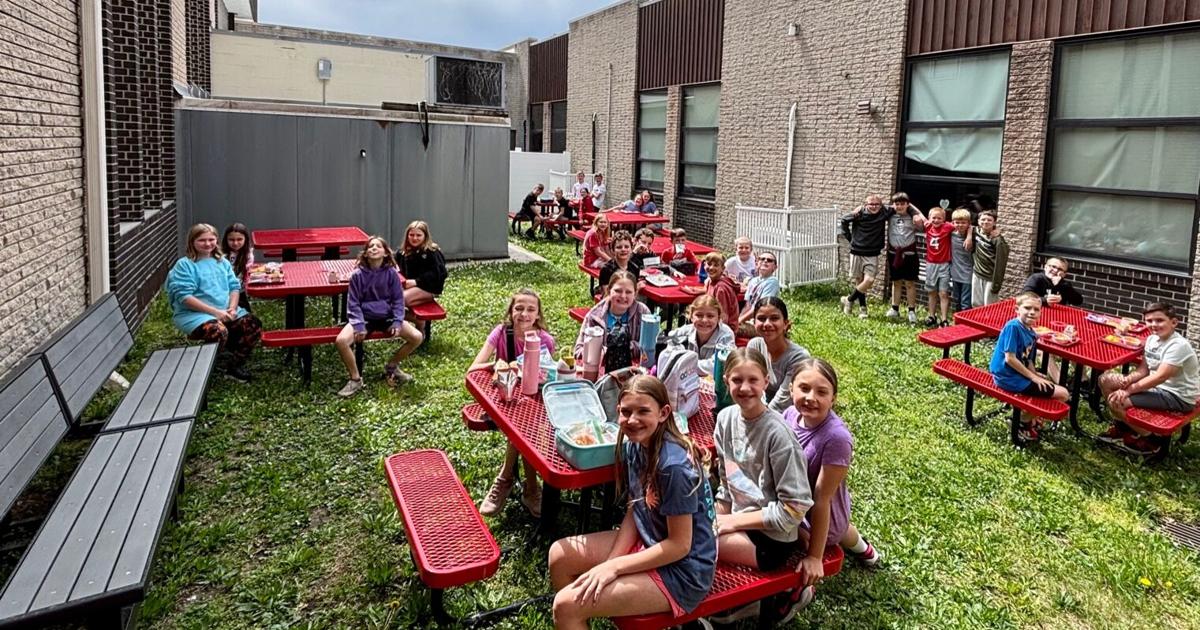
LIBERTY, Ill. — Students gather around picnic tables eating lunch in the Talon Terrace.
A chalkboard turns the space into an outdoor classroom ready to use later in the school day, while planters with flowers add bright splashes of color.
The space — enclosed by the cafeteria, small gym and elementary hallway — provides another opportunity for students at Liberty Elementary School to get outside.
Principal Jody Obert said the time outside matters for their mental health — and their learning.
“Whether it’s me or a student, when we’re in a good head space, we know we’re able to learn,” Obert said. “If we truly want to see quality performance from a student, we’ve got to make sure their social-emotional wellbeing is where it needs to be, as well as the teachers and our staff.”
A school-community relations committee, with help from the Liberty Education Foundation, spearheaded work last school year to create the outdoor space separate from the playground. Grants and community donations covered the more than $10,000 cost of the project, which also ties in with goals of Resilience-Supportive Schools Illinois, part of the state’s broader effort to improve student mental and behavioral health.
“In teaching kids in school, it’s more than math, reading and writing. It’s how to teach life skills they can use through many years,” Liberty Elementary counselor Aimee Hannel said. “Self-regulation, being mindful and aware of your emotional state can make an impact now and later in life.”
The free, data-informed initiative — recently rolled out statewide after a pilot year by the Illinois State Board of Education and the Center for Childhood Resilience at Ann and Robert H. Lurie Children’s Hospital of Chicago — provides schools with tools to strengthen student and educator mental health and resilience.
Schools start by completing a 15-minute survey in ISBE’s Web Application Security system. The information collected, combined with data from the Illinois Report Card and 5Essentials Survey, generates a personalized snapshot to help each school identify areas of strength and opportunity.
Schools then work with Social Emotional Learning, or SEL, Hubs and RSSI partners to develop and implement action plans focused on one or more of the initiative’s four foundational pillars — trauma-responsiveness and healing-centeredness, mental health, SEL and cultural awareness, responsiveness and equity.
“It is optional, but we hope that even just having the data is really good for schools to see and start thinking on,” said Leslie Vigor, director of SEL and trauma support with the Regional Office of Education No. 1 in Quincy. “It’s so abstract to think about SEL for some people. This is the first time it’s comprehensive, like academic assessment.”
RSSI builds on the Resilience Education to Advance Community Healing, or REACH, initiative, which has led to reduced chronic absenteeism, improved teacher retention and decreased use of suspensions in participating schools while improving capacity for trauma-responsiveness.
“Now instead of just having the trauma-responsive pillar, we have three other pillars that schools can use,” Vigor said. “There is more to SEL than trauma. Sometimes things need to be taken care of before we get to the trauma piece.”
Across the region, Vigor said schools who did REACH naturally transitioned into RSSI while others choose to continue focusing on trauma, to take the survey to access the data or to still consider opting into the initiative.
Quincy Public Schools in 2025-26, for example, will move into phase two of restorative practice training while reviewing trauma-informed practices, communication circles, classroom management and de-escalation techniques and continue to work with Vigor on trainings and professional development.
“Anytime there is an initiative with training for educators and anyone who’s working in school to help build capacity to better support learning and growth for children, that’s always a good thing,” QPS Director of Teaching and Learning Kim Dinkheller said. “Not all children come to us with the same level of learning, whether SEL or academic.”
Liberty worked with the ROE’s SEL coach Erica Kirlin to review its survey data and develop plans to add two treadmills and two exercise bikes in a space dedicated for staff use and to focus this year on professional development tied to trauma-informed and healing center practices to better support struggling kids.
Hannel said a grant from the Tracy Family Foundation allowed the elementary school to buy wireless wrist-based heart rate monitors and pedal desks designed to help students reduce stress and boost mental clarity.
“We’ve had a lot of positive feedback from the students on those,” Hannel said.
“We’re trying to support our learners to the best of our ability,” Obert said. “I know every school is working hard on creating these same environments, but I’m really proud of what we’re doing here at Liberty.”
link