Cultural participation and psychological wellbeing: the mediating role of transcendence
Over the past few decades, research on cultural participation has gained significant momentum, with growing attention to both its measurement (Schuster, 2007) and impacts on individual wellbeing (Stuckey and Nobel, 2010; Murtin and Zanobetti, 2024). However, there is a lack of theoretically informed studies on the mechanisms translating cultural participation to wellbeing benefits, particularly within non-Western populations. To address this key gap, the present research applies the transcendent character strengths from the VIA framework to develop and empirically test a mediation model, using data from a sample of Chinese youths. In the following sections, we discuss the main theoretical contributions of our findings (5.1 Theoretical Contributions) and highlight their practical and policy implications for both the mental health and cultural sectors (5.2 Practical Implications).
Theoretical contributions
First, consistent with prior seminal findings on this topic (Cuypers et al. 2012; Fancourt and Steptoe, 2018; Grossi et al. 2012), our results confirm a positive relationship between cultural participation and individual wellbeing. While this association is robustly tested in Western populations (e.g., Norwegian (Cuypers et al. 2012); English (Fancourt and Steptoe, 2018); Swedish (Konlaan et al. 2000); Italian (Grossi et al. 2012)), Chinese, and more broadly East Asian, populations are typically underrepresented in this literature (Lee et al. 2021). Our study addresses this gap by demonstrating that the favorable association between cultural participation and wellbeing extends to Chinese youth, thereby broadening the cross-cultural validity of these findings.
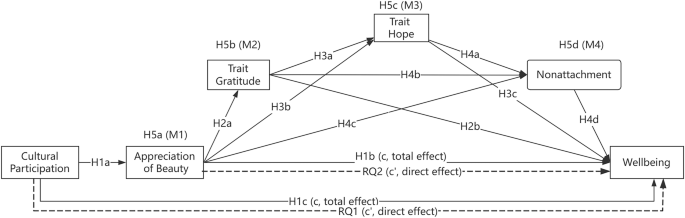
Second, our study goes beyond manifesting the association by clarifying the underlying psychological pathways through which cultural participation promotes wellbeing. While existing work has qualitatively explored the transformative potential of arts engagement (Sapouna and Pamer, 2014; Perkins et al. 2020) and shed light onto possible mediators such improved interpersonal relationships (Lee et al. 2021), our study, to our knowledge, provides the first quantitative evidence for a theoretically informed mediation model between cultural participation and wellbeing anchored in the VIA framework (Peterson and Seligman, 2004).
Third, our research extends the VIA framework with “nonattachment” – a secularized Buddhist concept – as a culturally resonant operationalization of the “spirituality” strength. This is particularly relevant to the context of contemporary China, where young people and emerging adults navigate through rapid social changes and face significant psychological strains from increasing living costs, growing competition for educational and career opportunities, and shifting family structures (Linyan and Boqing, 2023). Importantly, the concept of nonattachment in our study should not be confused with the “lying flat” (tangping) culture prevalent among young Chinese, characterized by a disengaged approach to life responsibilities and goals (Zhang and Li, 2023). Unlike the disengaged “lying flat” mindset, nonattachment promotes active engagement with the present moment, through “a flexible, balanced way for relating to one’s experience without clinging to or suppressing them” (Ho et al. 2022). Its role as the final mediator in our model suggests the wellbeing benefits of cultural participation are realized through a cascade of positive traits, culminating in the cultivation of nonattachment – a strength instrumental in coping with challenges in contemporary China.
Last but not least, our study reveals different pathways via which active, passive, and hybrid forms of cultural participation contribute to wellbeing. This must be interpreted within China’s unique cultural-technological contexts. For instance, the hybrid forms of cultural experiences – epitomized by the “Wandering in Dunhuang” virtual reality and “Meet Dunhuang” projection mapping exhibitions – have proliferated under national policies promoting cultural-technological integration (Zhao, 2025). Those emerging cultural experiences cater to the visually oriented and technologically savvy preferences of Chinese Generation Z. Yet our analysis demonstrates their pathways to wellbeing resemble that of traditional passive art appreciation – both start with sensory appreciation of beauty, progress to thankfulness and hopefulness for everyday blessings, and culminate in nonattachment. This suggests hybrid forms of cultural participation, which blend digital accessibility with cultural heritage, may represent a more accessible and pragmatic way for youths to engage with and benefit from the beauty of cultural heritage in fast-paced societies.
Practical implications
Building upon our findings, we now consider the implications of our research for both the mental health and cultural sectors.
First, our research provides empirical support for integrating cultural participation into community wellness initiatives and preventive mental health services in China. Despite numerous calls for utilizing public culture and arts to improve societal wellbeing (Camic and Chatterjee, 2013), empirical evidence drawing on Chinese samples has been scarce (Xia et al. 2024). Given the demonstrated link between cultural engagement and wellbeing in this study, policymakers should prioritize funding allocation to arts and cultural programs aimed to promote wellbeing.
Second, these programs should be designed to foster transcendent character strengths, as our study has found them to be the key mechanisms driving the psychological benefits of cultural participation. The sequence in which these character strengths mediate the relationship can also be informative. As AoB is the transcendent trait most proximal to cultural participation, art therapy sessions should be structured to initially focus on enhancing esthetic sensitivity and gradually progressing towards fostering gratitude, hope, and nonattachment, thereby promoting wellbeing.
Third, our research suggests developing metrics to assess the efficacy of cultural programs beyond mere attendance rates to encompass psychological outcomes, such as long-term cultivation of participants’ character strengths. This strength-focused framework, would align with the growing global shift towards evidence-based cultural policy (Belfiore and Bennett, 2007; Clift, 2012; Shefi et al. 2022), as it prioritizes how programs enhance wellbeing rather than whether participation occurs. Under this framework, cultural programs should be designed, reported, and evaluated through the lens of the targeted character strengths (e.g., trait AoB, gratitude, hope, nonattachment). Such practices will enhance the replicability of evidence, allow for more systematic evaluation of program outcomes, and enable the identification of best practices and areas for improvement over time (Fancourt and Finn, 2019). Such practices are also conducive to facilitating interdisciplinary knowledge exchange and cross-sectoral collaborations towards developing more targeted and sound programs (Daykin et al. 2017).
Limitations and further research
While providing valuable insights, several limitations should be noted in interpreting the findings of this study. First, the cross-sectional design was chosen as the most practical and appropriate approach for this initial study to establish model plausibility, in a topic area where theoretically informed studies are lacking. However, it inevitably limits our ability to infer causality between cultural participation and psychological well-being. Future research employing longitudinal and interventional approaches are preferable to further verify the directionality of these paths.
Second, the reliance on self-report data may potentially produce inaccuracy due to social desirability and recall biases. Future research may integrate objective measures, such as individual cultural expenditure or ticket purchase records, for improved accuracy.
Third, our research focuses specifically on Chinese youths, and the findings should primarily be interpreted within this cultural context. Variations in cultural participation, as well as the interpretation and importance of character strengths, may emerge when the research is conducted in other cultural contexts. A lack of research on the cultural participation of Western samples through the lens of transcendence prohibits such cross-cultural comparison. That said, the four transcendent character strengths examined in our study – trait AoB, gratitude, hope, and nonattachment – are conceptually applicable to broader human experiences. While their prominence or specific expression might vary across cultures, their role as mediators in the relationship between cultural participation and wellbeing is likely of transcultural relevance. Therefore, our study, which uncovers these mechanisms in a Chinese context, serves as a starting point for future cross-cultural studies to explore whether and how diverse cultural settings shape the relationships observed, which would provide a broader perspective on the universality or cultural specificity of the mechanisms identified.
Fourth, our choice to use a professional survey company’s panel service led to a sample that disproportionally represents certain demographics of the target population (i.e., Chinese youths). Specifically, it overrepresents students and younger youths under 24 years old, highly educated individuals, and those from middle- and high-income households in eastern China. Nevertheless, given the focus of this study on the internal relationships between cultural participation and wellbeing – including assessing the wellbeing gains of cultural participation beyond an economic threshold to examine the Easterlin paradox – the concentration on urban, high-income youths is acceptable and even desirable. Indeed, this demographic’s higher engagement in cultural activities has facilitated the discovery of the mechanisms linking cultural participation and wellbeing. Moreover, research suggests that the marginal effects of education, income, and urban (vs. rural) location on cultural participation are smaller in China, compared to Europe or the US, due to the Chinese government’s investment in building cultural infrastructure and promoting equal access to cultural services in recent years (Courty and Zhang, 2018). With that said, future studies should include more diverse populations, such as rural residents, individuals from lower-income households, and different age groups, to enhance the generalizability of the findings.
Finally, the significant unmediated effect of active participation on individual wellbeing suggests alternative mechanisms beyond those identified in this study. One possibility is the social benefits gained through shared experiences of cultural engagement, which are particularly valued in collectivist cultures (Hofstede, 2001; Lu and Gilmour, 2004). As many forms of active participation in China occur in group contexts, it is possible that the sense of belongingness, shared identity, and perceived social support fostered during this process may play a significant role (Lee et al. 2021; Cho, 2024). Therefore, future studies should seek to examine other character strengths (e.g., social intelligence) as alternative mechanisms linking cultural participation to wellbeing.
Conclusion
In conclusion, our study provides empirical evidence that artistic cultural participation contributes to Chinese youths’ wellbeing through the cultivation of transcendent character strengths – these include “nonattachment”, which we introduce as a culturally relevant facet of spirituality. Our findings also reveal how different forms of cultural participation contribute to wellbeing via pathways shaped by China’s unique cultural-technological context. Overall speaking, as individuals become more attuned to the beautiful, positive, and uplifting aspects of life through artistic cultural activities, they also become more appreciative of life’s transient nature and less burdened by the desire to control or change it. These results highlight the need for interdisciplinary partnerships between cultural institutions and mental health organizations to harness the power of cultural engagement in fostering a more fulfilled and resilient society.
link

:max_bytes(150000):strip_icc()/GettyImages-1093685452-ce524e5f089844e6977b49a69019b981.jpg "What Is Emotional Wellness?")