Horizon asks for ‘critical state protocol’ to ease hospital overcrowding
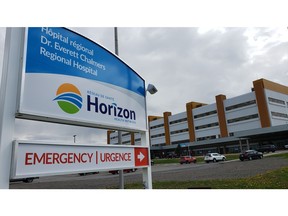
As hospitals struggle with summer surge, network says hundreds of people taking up beds don’t need to be there
Article content
Horizon Health Network has asked the province to let it enact its “critical state admission prioritization status” in a bid to ease overcrowding in hospitals and speed up the movement of alternate level of care (ALC) patients into long-term care facilities.
Advertisement 2

Article content
The move, which if approved would mean those ALC patients would move to the top of the wait list for placement in a long-term care facility of their choice, came as Horizon president and CEO Margaret Melanson revealed that the percentage of ALC patients taking up Horizon hospital beds has reached a record high – about 40 per cent.
It also came hours after Brunswick News reported that some of Horizon’s patients are being treated in hallways and “dining areas” because of overcrowding.
As of Tuesday afternoon, The Moncton Hospital was at 94 per cent of its capacity.
Saint John Regional Hospital was at 103 per cent, Fredericton’s Dr. Everett Chalmers Hospital was at 104 per cent, Miramichi Regional Hospital was at 106 per cent, and Upper River Valley Hospital in Waterville was at 137 per cent.
Advertisement 3
Article content
In Waterville, for example, that translates to 71 patients in the hospital, even though the capacity is 52 beds.
The overcrowding “has meant placing patients in makeshift rooms such as dining areas or in hallways until a proper room frees up,” Greg Doiron, Horizon’s vice president of clinical operations, said in a recent email to Brunswick News.
“The main reason for the high occupancy rate is the more than 650 patients who remain in Horizon hospitals but no longer require hospital-level service. They need the type of care a nursing home provides but have not yet been admitted. It is important to note that more than 360 of these patients could be discharged today if a long-term care bed were available.
“This is causing a compounding effect on the services the hospitals are providing as patients who should no longer be in the emergency department, but do need to be admitted to hospital, are waiting for a bed. Horizon continues to work toward addressing the safe, efficient placement of medically discharged patients to long-term care settings in collaboration with our partners, as beds become available in the community.”

Morning Email Telegraph-Journal
Article content
Advertisement 4
Article content
Last week, Brunswick News asked the Department of Social Development why the critical state protocol wasn’t already in place.
“Protocols are enacted when a hospital submits a request to the minister of social development to have critical state enacted,” department spokesperson Ariel Mackenzie said in an email, adding that there are three criteria the minister “may consider in approving such a request.”
They are:
- “The occupancy rate of the emergency room exceeds the capacity of the hospital facility and there are prolonged off-loading delays from ambulance bays;
- “The occupancy rate of acute care units exceeds the capacity of the hospital facility,” and;
- “Critical surgeries to be performed at the hospital facility are being cancelled due to a lack of available hospital beds.
Advertisement 5
Article content
“Critical state can be enacted for no longer than 30 days, after which the minister may make further determination,” Mackenzie noted.
But that all changed on Tuesday, when Horizon, via a press release, announced that it has asked to enact the protocol in Fredericton, Saint John, Miramichi and Waterville.
“This is not a request we make lightly, however, despite the great effort by staff and physicians to care for all inpatients, the current situation across our hospital system is unsustainable,” Melanson said in the press release.
“If enough long-term care beds were available in our communities today, we would be able to immediately discharge 360 of these patients from our hospitals. This is the highest number of ALC patients our hospital system has ever seen.
Advertisement 6
Article content
“This level of pressure has a profound impact on our entire health care system. It means fewer beds for patients who need surgery. It causes emergency department wait times to grow longer. It forces care to be delivered in hallways, dining areas, lounges, and other makeshift spaces – conditions that are far from ideal for patients, families, and staff.”
How the government responds to the request remains to be seen. Brunswick News asked social development for comment, but didn’t receive a response by deadline.
Hallway medicine
Amidst the overcrowding and ER chaos, Fredericton emergency room doctor Dr. Yogi Sehgal is warning of the dangers triaging or treating patients in hallways.
In a recent interview with Brunswick News, Sehgal said while he understands that for now the move is necessary, there’s lots of research that shows how detrimental hallway medicine is on patients, who struggle to get any rest because of the constant noise and “chaos.”
Advertisement 7
Article content
Sehgal applauded Horizon’s progress to improve the situation despite the “constraints” it’s working under, and noted that staffing levels have improved and that previously unused parts of Fredericton’s hospital have been reopened to accommodate more patients.
But the problem is systemic, and has been around for decades, he added.
“We can’t get people out of the (emergency) department to the floors and such. So we have the inpatients get stuck in our department, taking up all of the beds. And as Horizon is correct to point out … it’s not just the (Alternate Level of Care) patients. We have an aging, growing population as well,” Sehgal said.
“We’re paying a hospital to do a job as a hospital, but a third of its job right now is looking after patients that really should be looked after by community providers and social development … resources in the system that would allow them to be in the community instead of at a hospital. Imagine living in a hospital for a year waiting for a placement somewhere. Living in a hospital is not where anybody wants to live.”
Advertisement 8
Article content
Shoehorning patients into makeshift spaces isn’t a viable long-term answer either, he said.
“I don’t think we should ever accept that people – not just older adults, anybody – should be admitted in hallways. I looked this up in medical literature … people being admitted to the emergency room are more likely to die and older adults are more likely to get a delirium just because they’re admitted to the emergency room, because it’s not a stable environment, it’s a chaotic environment.”
There are multiple studies supporting what Sehgal said.
For example, according to a 2018 paper published in the American Journal of Emergency Medicine, a peer-reviewed “observational” study by six experts that involved more than 10,000 patients who were initially triaged in hallways concluded that they have “an increased odds of 30-day return to the (emergency department), observation and inpatient admission.”
Advertisement 9
Article content
The study also cited a survey of 60 Norwegian hospitals about hallway health care.
The survey, the study said, found that “head physicians and head nurses agree with statements that caring for patients in corridors reduces the quality of care, increases the risk of mistakes and accidents, increases the risk of infections, and decreases the amount of time spent by providers with patients.”
Sehgal said over the last 20 years, there have been plenty of warning signs that the problem was getting worse.
“We should have planned for this 20 years ago,” he said. “I’ve been here for 15 years in Fredericton, and I was working in Ontario for almost 15 years before that. We were talking about this when I trained in the 90s.
“This is not a new problem. We knew this was coming, so I don’t blame the current government or the previous government. This is decades in the making.”
Editor’s note: This is a developing story. There is a more recent article here.
Article content
link