Location of health clinics influenced by government ‘input’: Horizon CEO
Green party leader says site-selection process has been ‘politicized’
Article content
Horizon Health Network is relying on government “input” to determine the communities that will receive new or expanded family health teams, its top official has admitted.
Advertisement 2

Article content
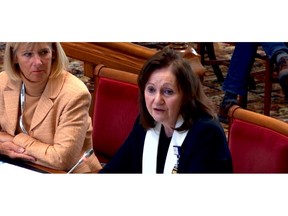
Margaret Melanson, president and CEO of Horizon Health Network, laid out the site-selection process while under questioning before a legislative committee Thursday.
Under the process, Horizon and the Holt government make a “joint decision” on the next site after the government reviews a list of Horizon’s recommended sites and provides input based on its priorities, Melanson told the committee.
Green party Leader David Coon challenged the Horizon CEO on why the provincial government is involved in the decision-making process.
“It seems to me that you’ve got a budget, you’ve got the data where the need is greatest for attaching people to health-care providers, and you can prioritize away and put the money where it’s needed,” Coon said.
When pressed if the site-selection process has been politicized, Melanson paused and reiterated there’s government “input.”
Advertisement 3
Article content
Coon later told Brunswick News he wasn’t surprised to hear that government input is shaping the process given the list of collaborative care announcements to date.
“That’s the only way you can explain the distribution of collaborative health clinics beyond the initial ones that they picked, which were already in progress and they just added on to them so it was low-hanging fruit,” Coon said in an interview.
Since last April, the Holt government has made 11 collaborative care clinic announcements across both Horizon and Vitalité health networks.
“No one wants their health care politicized, but that seems to be happening and it’s appalling,” Coon said, referring to the site-selection process.
Liberal MLA Sam Johnston disputed Thursday that the process has been politicized, arguing that need is determining the location of new or expanded clinics.

Morning Email Telegraph-Journal
Article content
Advertisement 4
Article content
“If you look at the location of the clinics already announced, it’s in diverse ridings in terms of political affiliation, in all areas of the province – north, south, east and west,” Johnston said in an interview.
“I know it’s challenging to be able to get to everybody as quick as we possibly can, but in working with Horizon Health and Vitalité, the procedure is objective and based on need as much as possible.”
When asked why Horizon can’t make the decision independently if it’s based on data, Johnston said the health minister, his department and the government are all integrated.
“One is not separate from the other, whether it’s this government or any other government in the past,” said Johnston, MLA for Miramichi Bay-Neguac.
“It’s a joint decision. It’s an inclusive decision that has to do with strategic location based on hierarchy of need.”
Advertisement 5
Article content
During Melanson’s appearance before the public accounts committee Thursday, Coon, MLA for Fredericton Lincoln, highlighted that 36 per cent of people in Health Zone 3 (Fredericton and River Valley) are without a primary care provider.
To date, Horizon has announced expansions of the Fredericton Northside Community Health Centre and the Carleton North Medical Clinic – two primary care practices within that health zone.
“If you look at where the greatest number of orphan patients are, which is Zone 3 where I live, I would say that it would appear the government is being very selective as to where they’re making these announcements,” Progressive Conservative MLA and health critic Bill Hogan said in an interview.
Horizon continues to lag on family health teams
Horizon is still playing catchup on establishing family health teams in New Brunswick compared to its francophone counterparts, the committee heard Thursday.
Advertisement 6
Article content
Melanson blamed the delay on a comprehensive primary care plan she was “quite dismayed” didn’t exist when she took over the role in 2022. She took over from Dr. John Dornan, now the province’s health minister.
Last April, after years of development, Horizon launched its own primary care strategy, pledging to match all patients without a family doctor within its catchment area to primary care providers by 2029.
But according to the most recent data, Horizon has rostered a fraction of the 41,000 unattached patients Vitalité Health Network has already connected to family health teams under the collaborative care model the francophone regional health authority implemented in 2023.
“Vitalité has been faster off the mark and we’re trying our best,” Melanson told the committee.
To date, Vitalité has 22 fully functioning family health teams, with another eight under development. Once those are completed, Vitalité expects its 30 teams will be enough to meet its patient needs.
Advertisement 7
Article content
By comparison, Horizon has seven new family health teams, with 13 currently in development. It’s also transitioning its 46 community health centres under the family health team model.
According to the health department’s 2024-25 annual report, Vitalité received $13 million that fiscal year to co-create and expand family health teams. It started off the fiscal year with 12 teams and that was expected to grow to 26.
Meanwhile, Horizon received $8 million to “enhance primary care services in three priority communities: Sackville, Sussex, and an expansion of the Brookside Clinic in Fredericton.”
Since then, the Holt government has flowed millions of more dollars into expanding the collaborative care model across both regional health authorities.
More than 127,000 people were reported to be on the New Brunswick’s primary care waitlist as of Jan. 1, but Premier Susan Holt recently pegged the actual number of unattached patients at 238,000 – an increase of 40,000 people in 2025 compared to 2024 – based on New Brunswick Health Council survey data.
Advertisement 8
Article content
Earlier this month, Stéphane Robichaud, CEO of the New Brunswick Health Council, told the public accounts committee that Holt’s figures were extrapolated from results of its primary care surveys – an approach his council doesn’t take when releasing percentages of surveyed residents without a primary care provider.
About 5,000 people participate in the annual survey, which goes to those aged 18 and older who live in a household, Robichaud said. This means certain demographic groups like children and special-care home residents wouldn’t be counted in the data.
“That’s why we wouldn’t extrapolate the population,” Robichaud told the committee.
Article content
link