Michigan Tech Unveils H-STEM Complex to Foster Innovation and Collaboration
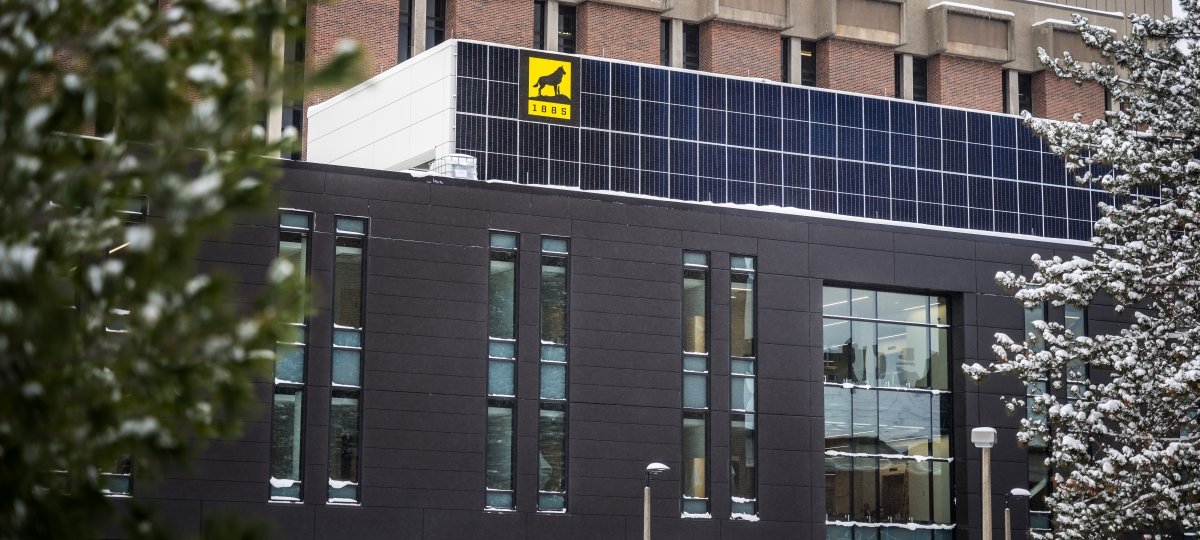
Michigan Tech’s H-STEM Complex, a new state-of-the-art facility built to advance interdisciplinary
research and education in health-related STEM fields, opened its doors in March.
After more than five years of planning and two years of construction, Michigan Technological
University announces the completion of the H-STEM Engineering and Health Technologies
Complex (H-STEM Complex). The state-of-the-art facility officially opened its doors
to the public March 11, becoming the most significant reflection yet of the University’s
commitment to advancing interdisciplinary health-related research and education.
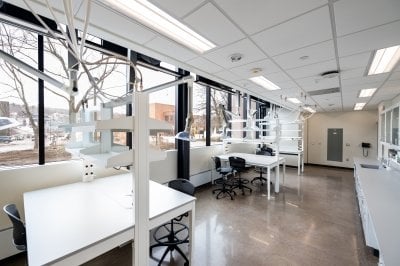
classroom spaces, driving the University’s commitment to advancing health-centered
technological research and education.
“The opening of the new H-STEM Complex ushers in a new era of health care innovation
at Michigan Tech,” said Rick Koubek, Michigan Tech’s president. “Coupling state-of-the-art
lab space with faculty expertise and innovative partnerships, the H-STEM Complex isn’t
just a building, it’s a hub for developing advanced technologies to improve health
outcomes for the citizens of Michigan and beyond.”
Designed to encourage collaborative research and integrated educational programs focusing
on health-related and human-centered technological innovation, the H-STEM Complex
will house transdisciplinary, hands-on and student-led research. With its STEM-focused
approach, the complex supports industry-relevant educational and research programs
in health and human-centered engineering, furthering Michigan Tech’s position as a
leader in technology and innovation.
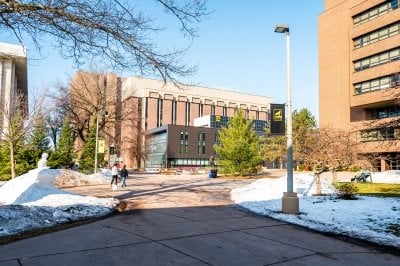
to leading health-centered technological advancements. Its strategic placement highlights
the University’s commitment to shaping the future of innovation and research.
Spanning approximately 63,000 square feet, the H-STEM Complex combines new shared
and flexible laboratory spaces with renovated classrooms and learning environments
within the existing Chemical Sciences and Engineering Building. Located in the heart
of campus, the complex includes multiple conference rooms, offices for 34 faculty,
work space for 84 graduate students, and three teaching labs. The building is on track
to be certified as LEED Gold for sustainability, with advanced features such as occupancy
sensors integrated into the lighting, air system and fume hood exhaust to increase
energy efficiency. In addition, a top-line HVAC energy recovery unit uses the hot
and cold air being vented from the building to help heat and cool incoming air.
“Having H-STEM at the center of campus is now a physical reminder that Michigan Tech
has a large presence in health engineering and science,” said Caryn Heldt, director of the Health Research Institute, professor of chemical engineering, and James and Lorna Mack Endowed Chair of Cellular
and Molecular Bioengineering. “Funding from the National Institutes of Health (NIH)
has tripled in the last decade at Michigan Tech. We are excited to see what increased
collaborations and research will occur now that we have a centralized location for
health-related research on campus.”
Heldt also highlighted the significance of the complex in regards to the University’s
future.
“Our goal is to develop cutting-edge health technologies that will save lives. In
the process, we are educating the next generation of entrepreneurs, scientists and
engineers who will lead Michigan and our nation to a brighter, healthier future.”
As a research institution, Michigan Tech is on track to achieve R1 status by 2025,
and continues to enhance its research efforts, educational programs and community
engagement. The H-STEM Complex is part of the University’s comprehensive Campus Master Plan, which outlines goals for growing enrollment at a steady, measured pace, attracting
top-caliber faculty and achieving a $300 million endowment. Notably, MTU’s last three
incoming classes have been the largest since the early 1980s, reflecting a clear trend
of increasing enrollment.
Steven Elmer, interim chair of the Department of Kinesiology and Integrative Physiology, emphasized
the potential of the H-STEM Complex to enhance innovation and foster collaboration
at Michigan Tech. “The H-STEM Complex offers the robust infrastructure needed to position
the department to become a nationally ranked kinesiology program,” he said. “Specifically,
it will help the department to increase research expenditures and number of doctorate
degrees awarded, both of which are critical as Michigan Tech transitions to an R1
university for 2025.”
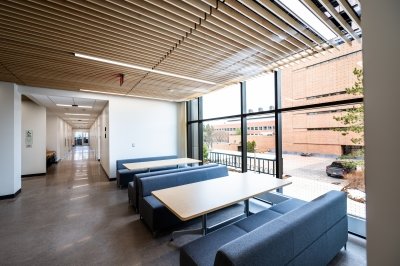
for focused learning and collaboration.
Among the new program additions at Michigan Tech is the Bachelor of Science in Nursing
degree, which illustrates Michigan Tech’s dedication to meeting evolving educational
needs in the region. “Michigan Tech values the role our work plays in supporting the
local community,” said Andrew Storer, provost and senior vice president for academic affairs. “The opening of the H-STEM
Complex and the nursing program increase the opportunities for the University to have
positive impacts on our community partners through enhanced research capacity and
education in the area of human health.”
Michigan Technological University is a public research university founded in 1885 in Houghton, Michigan, and is home to more than 7,000 students from 55 countries around the world. Consistently ranked among the best universities in the country for return on investment, Michigan’s flagship technological university offers more than 120 undergraduate and graduate degree programs in science and technology, engineering, computing, forestry, business and economics, health professions, humanities, mathematics, social sciences, and the arts. The rural campus is situated just miles from Lake Superior in Michigan’s Upper Peninsula, offering year-round opportunities for outdoor adventure.
link

/https://i.s3.glbimg.com/v1/AUTH_37554604729d4b2f9f3eb9ad8a691345/internal_photos/bs/2026/2/y/9lPUDnRg2LSa8QJdnNDA/foto05emp-101-einstein-b7.jpg "Einstein Hospital launches innovation hubs to export health tech")