Reduced hair cortisol concentrations are associated with improved emotional wellbeing in older adults following repeated forest walking
Subjects
The data presented here were collected as part of a previous study investigating the effects of a repeated walking intervention over one month (two 40-minute walking sessions per week), comparing forest and urban environments, on the heart rate variability and cognitive functioning in elderly individuals12. The study sample consisted of older adults of both sexes residing in Zvolen, Slovakia, an urbanised and industrialised area with a population of 43,000. Participants were recruited in collaboration with municipal social services and elderly subject welfare authorities. The minimum sample size of 52 participants was calculated using GPower 3.1, with parameters set for a medium effect size (Cohen’s d = 0.5), a significance level of 0.05, and a power of 0.80. Initially, 74 elderly subjects attended the first examination, and 54 of them met the inclusion criteria. Inclusion criteria required participants to be (1) aged 60 years or older, (2) able to walk independently, even with a walking aid, and (3) committed to participating for the entire month of investigation. In this study, participants using psychotropic drugs and/or corticosteroids were explicitly excluded. This exclusion criterion was implemented to minimize potential confounding effects on neuroendocrine outcomes. The remaining medication use among participants was registered and categorized as follows: (1) Hypertension medications, (2) Cardiovascular system medications, (3) Diabetes medications, (4) Medications for pain/inflammation (joints), (5) Medications for head and back pain, (6) Osteoporosis medications, (7) Medications for reflux, (8) No medication use. Exclusion criteria included residing in institutional care. A table showing baseline demographic and clinical characteristics for each group is presented in our earlier work12.
Ethics statement
This study was approved by the Ethical Committee of the Banska Bystrica Self-Governing Region for Biomedical Research, registration No. 37828100. The participants provided their written informed consent to participate in this study. For the publication of any potentially identifiable images included in this online open-access publication, written informed consent was duly obtained from the respective individual(s). The study was conducted in accordance with the ethical guidelines of the Declaration of Helsinki, as revised in 2000.
Study design and interventions
The study was performed from the 1st to the 31st of October 2021 in Central Slovakia. It employed a randomised, parallel-group intervention design, as described in detail previously12. The participants were recruited in collaboration with the municipal social and older adult welfare authorities from June to August 2021. Participants who fulfilled inclusion and exclusion criteria were assigned to two groups: forest walkers as the intervention group (forest, n = 27) and urban walkers (urban, n = 27) as the active control group. The random assignment of volunteers to the two groups was performed using a web-based research randomizer (www.randomizer.org) in a 1:1 ratio through simple randomization, i.e. subjects were assigned randomly into two groups, forest and urban. Determination of whether a subject would undergo forest or urban intervention was made by reference to a statistical series based on random sampling numbers by Prof. Viliam Pichler. Subjects were informed about their allocation 4 to 2 days before the start of the intervention, when the baseline data were collected and measurements were taken. Blinding from the specific research questions was conducted for participants and the research assistants.
Baseline data were collected four to two days before the start of the study, including psychological questionnaires and a health survey. Participants were instructed to complete two interventions per week, totalling eight visits over one month. Intervention times were randomly assigned to fit participants’ daily schedules. Each participant received their intervention schedule via mobile phone at the beginning of each week and was reminded one day before each session. On the day of the walking intervention, participants were individually transported to their assigned sites and met by a site assistant who reiterated the walking instructions. The use of cell phones, eating, and casual conversation was prohibited during the intervention, although drinking water was permitted. Assistants guided the participants by walking approximately 10 m ahead without interaction during the 40-minute sessions. These sessions consisted of 25–30 min of walking at a pace of approximately 3 km/h and 10 min of observing the environment from a portable chair or bench. The two parallel interventions were identical except for the environment, i.e., forest and urban. The trial ended according to protocol when all subjects completed eight scheduled interventions, i.e., after four weeks. The participants were instructed not to perform any unusual physical activities. They were also asked to refrain from walking in the environment opposite to the one they were assigned to for the study. All participants wore Garmin Venu SQ, a consumer wrist-worn fitness tracking device using photoplethysmography, GPS, and accelerometer sensors, 24 h a day during the whole intervention period. There were no differences in the number of steps between the groups. Only two participants from the forest walking group dropped out during the intervention period due to an unaligned schedule (1) and a fall at home (1).
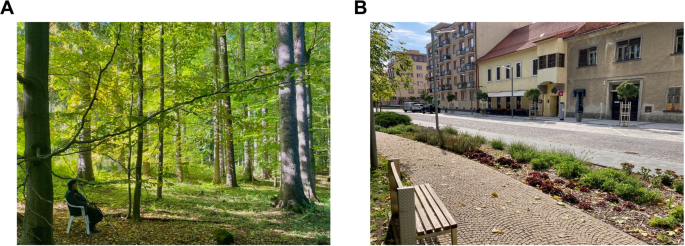
The intervention sites were carefully selected based on topographic data and field reconnaissance to ensure comfortable walking conditions on relatively even surfaces with a maximum inclination of 3° to avoid physical strain. The careful selection of multiple locations for both groups was aimed at minimizing boredom and fatigue among participants. For the forest interventions, three sites, and for the urban walking two cities were chosen. The forest sites contained semi-natural to natural forests within 15–30 min drive from the participant dwellings and comprised multiple tree species and trees of various ages, as preferred by the majority of forest visitors13. The key difference between forest and urban localities was the presence of closed forest canopy in the former sites and the built environment in the latter ones, as seen in Fig. 1. All experimental localities are described in detail in the paper by Lamatungga et al.12.

Photographs of the forest (A) and urban (B) localities used for the study interventions. Images were taken by co-author Viliam Pichler and are used with permission.
Measurements
Hair cortisol
Hair samples for cortisol measurement were collected two times, at baseline (the first day of walking) and after one month of walking intervention (the last day of walking) in a dedicated university hall. Hair was carefully cut with scissors as close as possible to the scalp from a posterior vertex position. The most proximal 1 cm of hair (about 10–25 mg), which enabled the measurement of a cumulative value for cortisol secretion during the last 1 month, was used for the analysis. Hair cortisol was measured using a modification of the methodology described by Balagova and Jezova14. Shortly, washed and dried hair samples were pulverized with ULTRA-TURRAX Tube Drive (IKA® Works, Inc., Wilmington, NC). The hair powder was eluted with 2 ml of methanol. After centrifugation, 1 ml of methanol was transferred into a new glass tube and evaporated at 50 °C in a water bath. The residue was diluted with phosphate buffer saline. Cortisol concentrations in hair extracts were measured by the Salivary Cortisol Enzyme Immunoassay (ELISA) kit (IBL International, Germany).
Salivary cortisol and alpha-amylase
Saliva samples were collected over two different days, initially at baseline (the first day of walking) and after a one-month walking intervention (the last day of walking). Two saliva samples were collected on each of these days, one in the morning and one in the afternoon, totalling four samples per participant. For the morning saliva collection, subjects were instructed to collect saliva samples at home before getting out of bed, 15–20 min after awakening. Saliva samples were collected into saliva sampling tubes (Salivette® device; Sarstedt, UK). The participants were asked to place the cotton roll in their mouth and allow it to saturate with saliva for 1–2 min. Saliva samples were stored in a freezer at − 20 °C until analysed. Concentrations of cortisol in saliva were determined using a commercially available enzyme-linked immunosorbent assay (IBL International, Germany). The intra- and inter-assay coefficients of variation were 2.9% and 5.0%, respectively. The activity of salivary alpha-amylase was measured by a commercially available kinetic reaction assay (Salimetrics, UK). Intra- and inter-assay variance was 2.4% and 3.5%, respectively.
Quality of life (QoL)
To assess health-related QoL, we employed the standardized Slovak version of the 36-item Short-Form Health Survey (SF-36). The SF-36 is a widely used, validated instrument designed to evaluate overall QoL in a comprehensive yet user-friendly format. The SF-36 includes eight health scales: physical functioning (10 items), role limitations due to physical health problems (4 items), pain (2 items), general health perceptions (5 items), emotional well-being (5 items), role limitations due to emotional problems (3 items), social functioning (2 items), and energy/fatigue (4 items)15. These scales are aggregated into two distinct summary dimensions: (1) Physical health which reflects the combined scores of scales primarily related to physical health, including physical functioning, role limitations due to physical health, pain, and general health perceptions, and (2) Mental health which reflects the combined scores of scales primarily associated with mental health, encompassing emotional well-being, role limitations due to emotional problems, social functioning, and energy. Each scale is scored from 0 to 100, with higher scores indicating better perceived health and quality of life. The survey was administered at the beginning of the study and the end of the intervention period in a dedicated university hall.
State and trait anxiety
The Slovak version of the State-Trait Anxiety Inventory (STAI) was used for the evaluation of state and trait anxiety16. The questionnaire consists of two subscales specifically examining the state (STAI-X1) and trait anxiety (STAI-X2) dimensions. Both subscales contain 20 self-statements, to which participants must respond on a 1–4 scale, yielding total scores of 20–80. For the trait subscale, the subjects are instructed to have their responses based on how they generally feel, while for the state subscale, they are asked to respond how they feel at that moment. STAI-X1 was administered at the beginning of the study and after one month of walking intervention. STAI-X2 was administered only once, at the time of baseline examination in a dedicated university hall.
Data availability section
The data that support the findings of this study are not openly available due to reasons of sensitivity and are available from the corresponding author upon reasonable request. Data are located in controlled access data storage at the Biomedical Research Center of the Slovak Academy of Sciences.
Statistics
Data were checked for normality of distribution by the Shapiro-Wilk test. Descriptive statistics and boxplots indicated nine outlying observations (values exceeding ± 1.5 interquartile range) for both alpha-amylase and cortisol concentrations. Consequently, the data were winsorized (using 20% two-sided quantile trimming as recommended by Wilcox and Keselman17 before statistical modelling.
The effects of group and intervention on hair cortisol, salivary cortisol concentrations, and alpha-amylase activity, as well as on state anxiety, were evaluated by repeated measures ANOVA for factors intervention (baseline vs. completion of interventions) and group (forest vs. urban environment) with sex included as a covariate. This approach allowed us to control for potential confounding effects of sex on the outcomes. Whenever interaction reached significance, the Tukey post hoc test was performed. To evaluate changes in salivary cortisol and alpha-amylase, repeated measures ANOVA for factors time (morning vs. afternoon) and group (forest vs. urban environment) with sex included as a covariate was used. Whenever interaction reached significance, the Tukey post hoc test was performed. For the SF-36 survey data, a Mann-Whitney U test was initially used to assess differences between the two environments due to non-normal data distribution. No significant differences were found between the forest and urban groups. Subsequently, a Wilcoxon signed-rank test was performed to examine within-group comparisons before and after the intervention. To assess differences in the distribution of medication use between the urban and forest groups, chi-square tests of independence for each medication category were performed. Medication use was coded as binary (1 = use, 0 = non-use) across eight categories. All other data were analysed by a t-test for independent groups. Pearson’s correlation analyses were computed to determine relationships between hair cortisol concentrations and SF-36 scales. Results are expressed as means ± SD. The overall level of statistical significance was defined as p < 0.05. The statistical analyses were performed with SPSS or Statistica 9.0 statistical software.
link

:max_bytes(150000):strip_icc()/GettyImages-1093685452-ce524e5f089844e6977b49a69019b981.jpg "What Is Emotional Wellness?")